The Treasure at Home: From Sanai, Attar, and Rumi to Paulo Coelho’s The Alchemist — The Ontology of the Quest Archetype
An ontological, mystical, and intertextual exploration of ATU 1645 (The Treasure at Home) and the Hero's journey towards self-actualization.
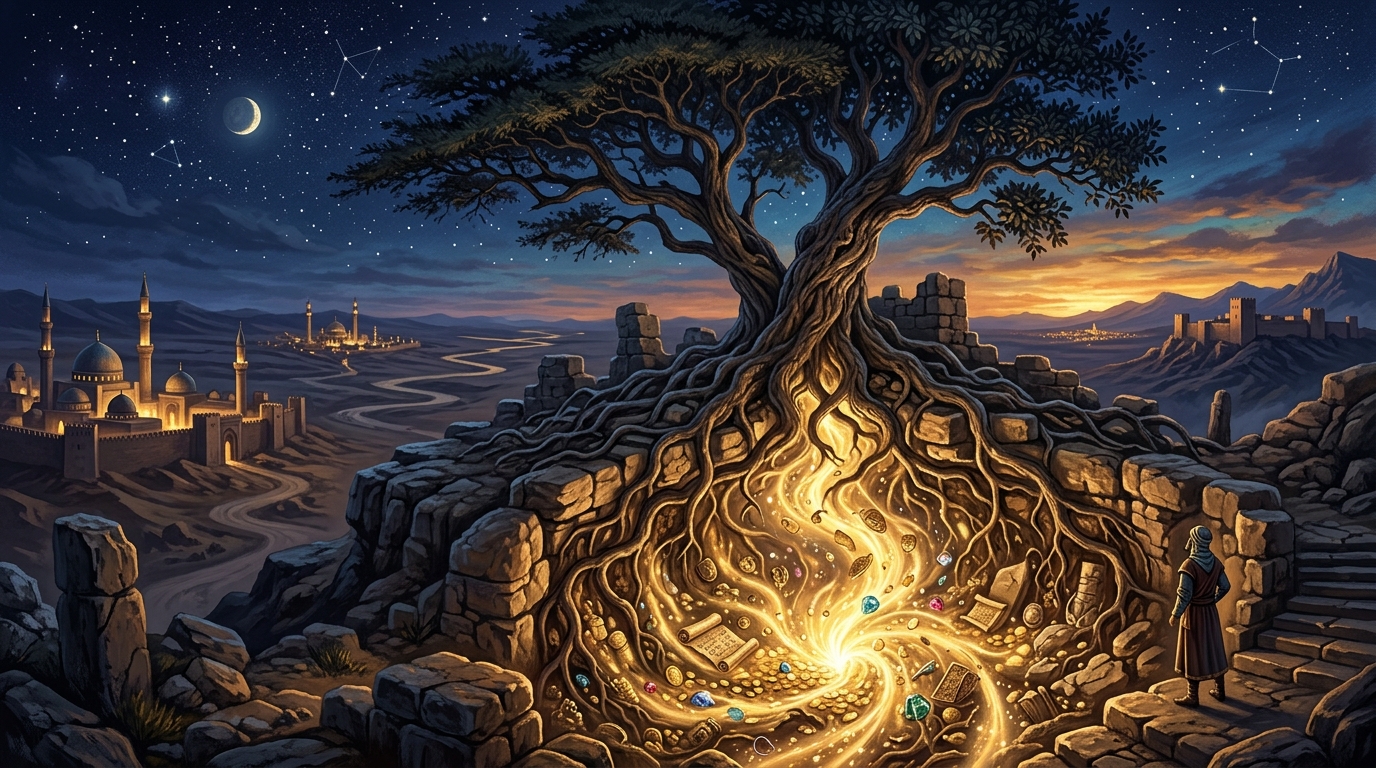
“Truth is concealed within the very essence of human nature; yet to attain the consciousness worthy of unveiling that hidden treasure, one must endure the tribulations of wandering across the entire cosmos, experiencing alienation, and embarking upon the journey.”
Abstract and Theoretical Framework
This study explores the ontological, mystical, and intertextual trajectory of one of humanity’s most enduring narrative motifs, classified in the Aarne-Thompson-Uther index as ATU 1645 (The Treasure at Home).
The narrative archetype—in which an individual falls into poverty in their homeland, sets out on a perilous journey inspired by a dream to seek a treasure in a distant land, endures severe trials, alienation, and violence, only to learn through an ironic revelation that the treasure was buried back in their own home—serves as the foundational allegory for epistemological transformation and spiritual self-actualization (al-Insān al-Kāmil) in Eastern and Islamic mysticism.
This comprehensive essay analyzes:
- Hakim Sanai’s philosophical-didactic foundation in Hadiqat al-Haqiqa (1131),
- Farid ud-Din Attar’s allegorical framework in Mantiq al-Tayr (The Conference of the Birds) and Musibat-nama,
- Jalal al-Din Rumi’s dialectical and metaphysical commentary in Book VI of the Masnavi (1273),
- The transmission of the archetype into Western world literature via The Arabian Nights (Night 351) and Jorge Luis Borges’ “The Tale of the Two Dreamers” (1935), culminating in Paulo Coelho’s global masterpiece The Alchemist (O Alquimista, 1988),
- A theoretical synthesis integrating Joseph Campbell’s Monomyth model and Carl Gustav Jung’s theory of Individuation.
1. Introduction: The Two Faces of the Journey and the Typology of Quest
In the cultural history of humankind, the act of physical displacement has never been merely geographical; it has perpetually functioned as a threshold of initiation signifying the transcendence of conscious awareness and the metamorphosis of the Self. From ancient mythology to Sufism, from folk narratives to modern literature, the central existential question remains: Does one find what they seek on the road, at the destination, or at the very point of departure?
1.1. The Monomyth and the Sufi Path (Sayr wa Suluk)
In comparative mythology, Joseph Campbell (The Hero with a Thousand Faces) articulates the universal journey of humanity through three overarching cycles:
- Departure (Separation): The hero experiences a profound lack (existential crisis, poverty, drought, spiritual collapse) in their mundane world and crosses the threshold upon hearing the call to adventure.
- Initiation (The Road of Trials): The hero encounters threshold guardians, trials, and adversaries in the unfamiliar realm, slaying their former ego-identity through suffering and gaining an enlightened perception.
- Return: The hero carries the ultimate boon (the elixir, the wisdom, the treasure) back to the primordial world to restore harmony and selfhood.
In Islamic mysticism, this cycle mirrors the spiritual progression of Sayr wa Suluk (the path of inner purification). The seeker (salik) ascends through four distinct stations:
- Sayr ila Allah (the journey towards God through renunciation of the illusory world),
- Sayr fi Allah (dissolution of the mortal ego in divine attributes / fana),
- Sayr ma’a Allah (subsistence in divine unity / baqa),
- Sayr fi al-khalq bi-Allah (the enlightened return to the mundane world of creation to live in harmony / ruju’).
Both Campbell’s monomyth and the Sufi doctrine converge on a single principle: the ultimate goal is never perpetual exile, but returning to the primordial foundation with a transformed, enlightened consciousness.
       [1. SEPARATION / DEPARTURE]
       (Crisis, Dream, The Call to Quest)
                   │
                   ▼
     [2. INITIATION / ROAD OF TRIALS]
     (Alienation, Suffering, The Irony of the Guard)
                   │
                   ▼
       [3. RETURN & INTEGRATION / RUJU']
    (Unearthing the Treasure in One's Own Soil)
1.2. The Universal Typology of ATU 1645 (The Treasure at Home)
In the Aarne-Thompson-Uther narrative classification, ATU 1645 embodies this philosophical structure through six universal motifs:
- The State of Lack: The protagonist loses all worldly possessions in their native city.
- The Oneiric Summons: A nocturnal dream reveals that immense wealth awaits in a distant realm (e.g., Cairo, Egypt).
- The Arduous Pilgrimage: The seeker embarks on an exhausting journey across hostile terrain.
- The Climax of Violence: Upon arrival, the seeker is mistaken for a criminal by city watchmen, captured, and beaten.
- The Ironic Revelation: The watchman ridicules the seeker for chasing dreams, declaring that he too frequently dreams of a treasure buried under a specific tree in the seeker’s own courtyard in Baghdad, but was never foolish enough to travel for it.
- The Return and Unearthing: Recognizing their own courtyard in the watchman’s words, the seeker rushes back home, excavates the soil, and claims the buried gold.
2. The Philosophical Foundation: Hakim Sanai of Ghazna (d. 1131)
Hakim Sanai was the pioneer who transformed Persian poetry from court panegyrics into a profound vehicle for mystical metaphysics. His seminal work, Hadiqat al-Haqiqa (1131), laid the epistemological groundwork for all subsequent Sufi poets.
2.1. Ontological Bankruptcy and the Buried Treasure (Ganj-i Pinhan)
Sanai constructs the metaphysical core of the narrative: human existence in the material world is a tragedy of forgetfulness (ghaflah). Having experienced the primordial covenant (alast), the divine spark (Ganj-i Pinhan / The Hidden Treasure) was deposited within the human heart. Yet, upon descending into the physical body, man forgot this divine inheritance and perceived himself as destitute.
Sanai uses an unforgettable allegory:
Humanity resembles a destitute beggar sitting in the courtyard of a ruined house, crying for a morsel of dry bread from passersby, utterly oblivious to the fact that beneath the very earth he sits on lies an inexhaustible chest of gold.
2.2. The Critique of External Seeking
Sanai harshly critiques seeking fulfillment in the external world (wealth, prestige, scholastic dogma). To seek the divine outside oneself is akin to extinguishing one’s lantern in the dead of night to search for the sun beneath street lamps. Enlightenment requires not physical movement, but the awakening of inner sight (basirah).
3. Symbolic Allegory and the Spirit: Farid ud-Din Attar (d. 1221)
Farid ud-Din Attar elevated Sanai’s didactic foundation into ecstatic narrative poetry.
3.1. The Conference of the Birds (Mantiq al-Tayr)
Attar’s masterpiece is the macrocosmic manifestation of the Treasure at Home archetype:
- Thousands of birds set out on a perilous quest across seven daunting valleys (Yearning, Love, Insight, Detachment, Unity, Bewilderment, and Self-Naughting) to find their sovereign king, the Simurgh.
- After countless perish, only thirty birds (Persian: Si-murgh) reach the summit of Mount Qaf.
- Admitted into the presence of the King, they gaze into a polished mirror and realize that they themselves are the Simurgh.
[DEPARTURE: The Kingdom of Birds]
                │
                ▼
[SEVEN VALLEYS: Yearning → Love → Insight → Detachment → Unity → Bewilderment → Annihilation]
                │
                ▼
[SUMMIT OF MOUNT QAF: The Mirror Chamber]
                │
                ▼
[EPIPHANY: 30 Birds (Si-murgh) = The Sovereign (Simurgh)]
3.2. Attar’s Formulation of the Cairo Story
In his secondary narratives, Attar recounts the man seeking treasure in Egypt and formulates two spiritual laws:
- The Paradox of Necessary Exile: The seeker could never discover the treasure by simply remaining at home with a shovel, because unearthing the treasure requires cultivating a soul worthy of receiving it.
- The Cure of Alienation: The suffering of exile breaks the idols of the false ego (nafs), leaving the seeker receptive to pure truth.
4. Dialectical Depth and Unity: Jalal al-Din Rumi (d. 1273)
Rumi reveres his predecessors in a famous distich:
“Attar was the spirit, and Sanai its two eyes; we have come in the footsteps of Sanai and Attar.”
In Book VI of the Masnavi, Rumi provides the definitive esoteric commentary on the Baghdad man’s journey to Cairo:
- Baghdad: Represents the primordial, uncorrupted human nature (fitrah) and the seat of the heart.
- Poverty: Represents the disillusionment with worldly desires that ignites genuine spiritual seeking (talab).
- The Beating in Cairo (The Manifestation of Majesty / Jalal): Represents the crushing of intellectual pride and self-reliance, driving the ego into absolute surrender (faqr).
- The Watchman’s Mockery: The watchman represents the pragmatic, rational mind that sees the vision but refuses to pay the price. Through divine irony, the truth is voiced by one who lacks the faith to pursue it.
4.1. The Central Paradox: Was the Journey in Vain?
Rumi resolves the ultimate existential question: If the treasure was in his own house all along, what was the purpose of walking hundreds of miles and enduring the beating?
Rumi’s answer is profound:
Had he remained in Baghdad, he would have starved to death on top of the treasure. Distance, alienation, and suffering were essential to strip away the veil of familiarity.
The journey did not create the treasure; the journey transformed the man into someone capable of recognizing it.
5. From East to West: Arabian Nights, Borges, and Paulo Coelho
The archetype traveled across centuries and cultures:
[SANAI (1131)] ➔ [ATTAR (1177)] ➔ [RUMI (1273)]
                       │
                       ▼
         [THE ARABIAN NIGHTS (Night 351)]
                       │
                       ▼
      [JORGE LUIS BORGES: A Universal History of Iniquity (1935)]
                       │
                       ▼
        [PAULO COELHO: The Alchemist (1988)]
Comparative Analysis: Rumi’s Masnavi vs. Coelho’s The Alchemist
| Structural Element | Masnavi (Rumi) | The Alchemist (Paulo Coelho) |
|---|---|---|
| Protagonist | Impoverished Muslim of Baghdad | Andalusian Shepherd Santiago |
| Origin Point | Baghdad (Courtyard of ruined house) | Andalusia (Abandoned church) |
| The Call / Dream | Dream of treasure in Cairo | Dream of treasure at Egyptian Pyramids |
| Threshold Crossed | Desert crossing (Baghdad → Cairo) | Tarifa → Sahara Desert → Pyramids |
| Spiritual Guide | Unseen Voice of Grace | Melchizedek & The Alchemist |
| The Ordeal / Violence | Beating by Cairo Night Watchman | Torture by Bedouin Bandits at Pyramids |
| The Revealer | Skeptical Watchman laughing at Baghdad | Bandit Leader laughing at Andalusian Church |
| Buried Location | Beneath the tree in Baghdad courtyard | Beneath roots of Sycamore in ruined church |
| Core Concept | Sayr wa Suluk / Self-Knowledge | Personal Legend / Destiny |
| Cosmic Harmony | Wahdat al-Wujud / Divine Unity | The Soul of the World |
6. Philosophical Synthesis: The Dialectic of Transformation
The apparent contradiction between the modern proverb “Do not search where you lost it” and the mystical doctrine of “The Treasure at Home” resolves into three dialectical stages of consciousness:
                 [STAGE 1: DIAGNOSIS & DEPARTURE]
                 "Flee the toxic soil that consumes you!"
               (Leave environments of stagnation & defeat)
                                  │
                                  ▼
                 [STAGE 2: THE EXTERNAL CRUCIBLE]
             (Exile, Desert Storms, Tests of Endurance)
                                  │
                                  ▼
                 [STAGE 3: THE ENLIGHTENED RETURN]
             (Integration with Primordial Potential)
                                  │
                                  ▼
[FINAL BOON: THE TREASURE AT HOME]- Diagnosis and Departure: One must break free from deadening, unfulfilling environments.
- The External Crucible: Wandering through the foreign realm breaks egoic pride and refines the spirit.
- The Enlightened Return (Ruju’): Having gained new vision, the seeker returns to their primordial essence to unearth the true wealth that was always there.
7. Conclusion
From Hakim Sanai’s philosophical roots to Attar’s mystical birds, from Rumi’s dialectical verses to Paulo Coelho’s modern narrative, The Treasure at Home illuminates an eternal law of human existence:
Truth is buried within your very soul; but to earn the vision worthy of uncovering it, you must be brave enough to journey across the entire world.
You leave home to find what was lost, only to arrive where you started—seeing it for the very first time.
Bibliography
- Attar, Farid ud-Din. The Conference of the Birds (Mantiq al-Tayr). Trans. Afkham Darbandi and Dick Davis. London: Penguin Classics, 1984.
- Borges, Jorge Luis. A Universal History of Iniquity (Historia universal de la infamia). Trans. Norman Thomas di Giovanni. New York: E. P. Dutton, 1972.
- Campbell, Joseph. The Hero with a Thousand Faces. Princeton: Princeton University Press, 1949.
- Coelho, Paulo. The Alchemist (O Alquimista). Trans. Alan R. Clarke. San Francisco: HarperSanFrancisco, 1993.
- Felek, Özgen. “From Tale to Novel: Traces of the Masnavi in Paulo Coelho’s The Alchemist”. Journal of Sufi Studies, Vol. 14, 2005.
- Jung, Carl Gustav. The Archetypes and the Collective Unconscious. Collected Works Vol. 9, Part 1. Princeton: Princeton University Press, 1969.
- Rumi, Jalal al-Din. The Mathnawi of Jalalu’ddin Rumi (6 Volumes). Trans. and Commentary by Reynold A. Nicholson. London: Luzac & Co., 1925–1940.
- Sanai al-Ghaznavi, Hakim. The Walled Garden of Truth (Hadiqat al-Haqiqa). Ed. Mudarris Razavi. Tehran: University of Tehran Press, 1980.
- Uther, Hans-Jörg. The Types of International Folktales: A Classification and Bibliography. FF Communications No. 284–286. Helsinki: Academia Scientiarum Fennica, 2004.
🏛️ Tedebbur Note & Contact
This monograph is published as part of the tedebbur.net philosophical and mystical contemplation archive. To explore more research on archetypes, Eastern-Western intertextuality, and existential quests:
- 🌐 Web: tedebbur.net
- ✍️ Author: deficient